Semantic Recession Detection: How Search Queries Reveal Market Stress Before Statistics Do
May 2026 Update: The Global 8-Point Semantic Model for Market Stress Analysis
Executive Summary
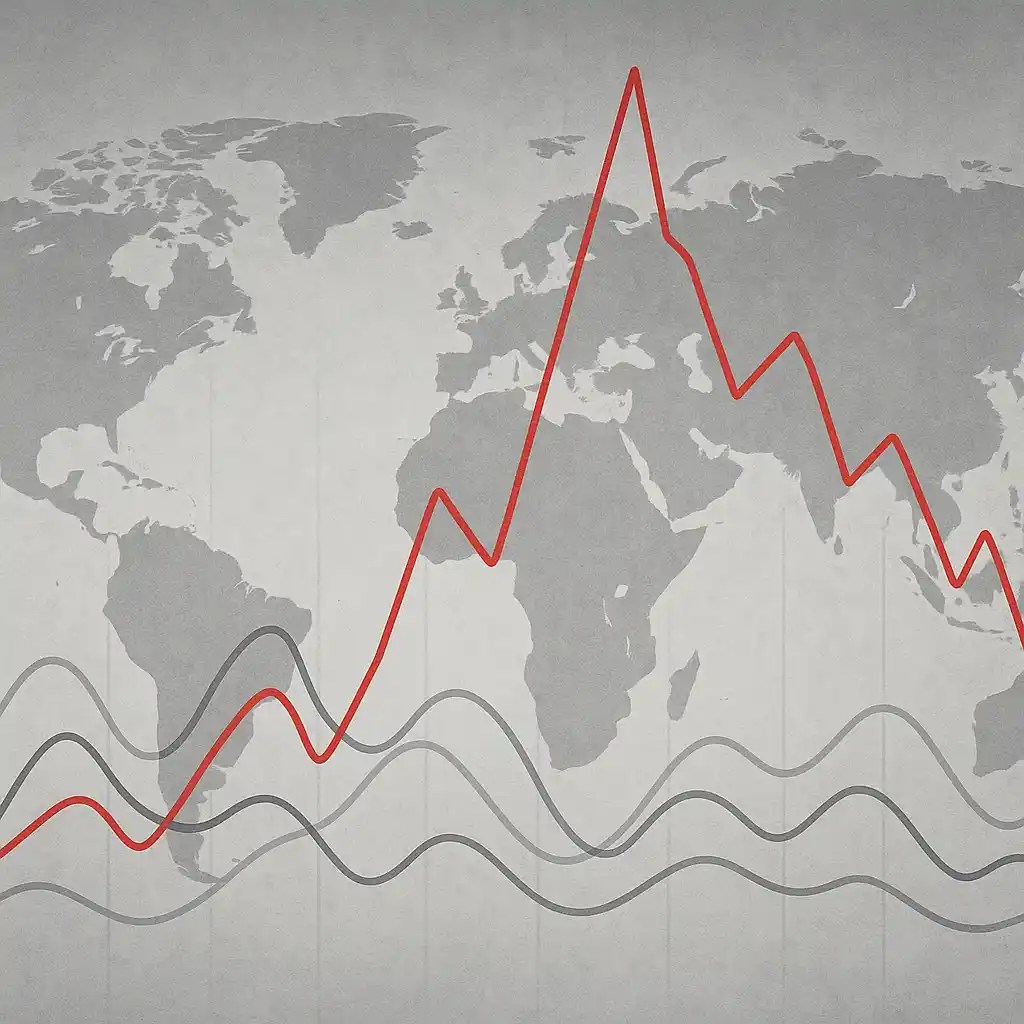
Search queries are one of the earliest observable layers of economic stress. Before official statistics fully capture a downturn, people often begin to change the way they search: for prices, currency protection, cheaper alternatives, job security, energy costs, debt management, food prices, relocation options, or basic infrastructure reliability.
This article introduces an 8-point model for semantic recession detection. It shows how six countries — Argentina, Mexico, Spain, India, Nigeria, and South Africa — express economic pressure through different words, but often follow comparable semantic patterns. For international SEO, brand positioning, market intelligence, and AI visibility, the decisive information is rarely the keyword alone. It is the meaning space from which that keyword emerges.
What Is Semantic Recession Detection?
Semantic Recession Detection is a market-intelligence method that analyzes search queries, semantic clusters, and intent shifts to identify early signs of economic stress, changing consumer behavior, and market uncertainty.
It is different from classic SEO keyword research because it does not start with ranking potential or search volume. It starts with meaning: what people are worried about, what they are trying to protect, which categories become risky, and how a society translates economic pressure into search behavior.
It is also different from simple Google Trends monitoring. Google Trends can show whether a query rises or falls. Semantic Recession Detection asks why a cluster of related queries appears, which stress domain it belongs to, and whether the signal reflects financial stress, consumption reduction, future anxiety, or systemic bottlenecks.
The method is not a replacement for macroeconomic forecasting. It is an additional semantic layer that helps analysts, SEO teams, and international market strategists detect weak signals before they become fully visible in official statistics.
May 2026 Update: Why This Framework Needs Recalibration
The original version of this article was written in November 2025. Since then, several country examples have changed. Argentina is no longer only an inflation-shock case, but increasingly a case of disinflation, confidence rebuilding, reserves, and purchasing-power adjustment. South Africa is no longer a simple live example of daily blackout stress after Eskom reported 365 days without loadshedding in May 2026. India’s gold signal has become stronger as investment demand rose sharply in Q1 2026. Nigeria’s food inflation remains a central social stress signal, but must be read against statistical rebasing and changing inflation dynamics.
This does not weaken the model. It strengthens it. Semantic market intelligence is not about freezing a country into one crisis narrative. It is about observing when the language of stress changes.
Table of Contents
- Executive Summary
- What Is Semantic Recession Detection?
- May 2026 Update
- I. The Thesis
- II. Methodological Note
- III. The Four Query Domains That Make Market Stress Visible
- IV. Six Countries — Six Languages of Economic Stress
- V. Universal Patterns
- VI. The 8-Point Semantic Recession Detection Model
- VII. May 2026 Evidence Layer
- VIII. What This Means for SEO, AI Visibility & International Strategy
- IX. Limits of the Model
- X. FAQ
- XI. Conclusion
I. The Thesis
Economic crises do not begin only in GDP figures, inflation tables, bond markets, or political speeches. They also begin in the language people use when they search for help, orientation, protection, alternatives, or escape.
When households and companies feel pressure, search behavior shifts. People start calculating in public search fields:
This language is not random. It is structured, repeated, culturally shaped, and economically meaningful. Argentina talks about currency. India talks about gold. Spain talks about unemployment, state support, and energy. Nigeria talks about food, currency, and exit options. South Africa has historically talked about electricity and grid reliability. Mexico often processes pressure through debt, efficiency, savings, and everyday optimization.
The words differ, but the deeper semantic domains are comparable:
Financial stress. Consumption reduction. Future anxiety. Systemic bottlenecks.
Whoever understands how a market searches during stress can often detect changes in economic behavior earlier than through traditional market reporting alone — and can understand how people redefine consumption, trust, risk, and brands during periods of uncertainty.
This does not mean search data replaces macroeconomic data. It means search behavior adds a behavioral and semantic layer that traditional datasets often reveal later.
II. Methodological Note: This Is Not a Forecasting Shortcut
Semantic recession detection is not a stand-alone recession forecast. It is a market-intelligence method for identifying early stress signals, changing priorities, and shifts in meaning. It should be combined with official statistics, local knowledge, SERP analysis, Google Trends, industry data, news signals, and qualitative interpretation.
The model is most useful when it is treated as a hypothesis generator: it helps ask better questions about a market before the standard data fully explains what is happening.
In practice, the method works by observing:
- whether cost-related queries are rising,
- which categories become associated with risk or insecurity,
- whether people search for substitutes, repairs, second-hand products, or smaller commitments,
- whether search language shifts from aspiration to protection,
- whether infrastructure queries become part of everyday planning,
- whether exit-related queries rise as a psychological signal.
The important point is not one keyword. It is the cluster. A single query can be seasonal, media-driven, or temporary. A semantic cluster across multiple domains is more meaningful.
III. The Four Query Domains That Make Market Stress Visible
When a country slides into economic stress, search behavior often shifts along four meaning domains. These domains appear in different countries, cultures, and languages — but the local vocabulary differs.
Financial Stress
When people recalculate stability
The earliest marker. People begin to calculate risk, purchasing power, and monthly survival.
Consumption Reduction
When everyday consumption reorganizes
Consumption rarely disappears completely. It shifts into lower-risk, lower-cost, more rationalized patterns.
Future Anxiety
When uncertainty becomes searchable
This is not only economic. It shapes trust, mobility, consumption, education, and brand decisions.
Systemic Bottlenecks
When infrastructure becomes part of market risk
At this stage, people no longer search only for prices. They search for whether systems still work.
These four domains form the foundation of the model. They explain why different countries can show similar economic stress through completely different words.
IV. Six Countries — Six Languages of Economic Stress
Every market has its own crisis language. The pressure may be economic, but the language is cultural, institutional, and historical.
Argentina — The Crisis Is Still a Currency, But the Meaning Has Changed
Argentina remains one of the clearest examples of currency-driven search semantics. During the 2023 inflation shock, queries around dólar blue, inflación hoy, and cómo ahorrar en dólares expressed immediate purchasing-power anxiety. By May 2026, the semantic question is more nuanced: inflation has fallen strongly from the 2023 peak, but searches around the dollar, reserves, purchasing power, imports, salaries, and price stability remain central because trust is not rebuilt at the same speed as macro indicators.
Mexico — Debt, Efficiency, and Everyday Optimization
Mexico’s stress language is often pragmatic. Queries around debt repayment, savings, credit, side income, price comparison, and efficiency reflect a market where households and small businesses often process pressure through optimization rather than dramatic crisis language. The semantic field is less about collapse and more about managing constraints.
Spain — Work, Energy, State Support, and Social Stability
Spain’s economic stress language is strongly connected to labor-market concerns, energy costs, rent, state support, and household stability. Queries such as paro, ayuda alquiler, precio luz, and bono social show how economic uncertainty is processed through institutions, public support, and household budgets. Even when headline indicators improve, Spain’s search semantics often remain sensitive to job security and cost-of-living pressure.
India — Gold as a Cultural and Financial Security Anchor
India shows how a market can express uncertainty through a culturally embedded asset. Gold is not only a luxury category. It is also a financial, family, symbolic, and generational security anchor. In Q1 2026, Indian gold investment demand rose sharply, confirming that gold-related queries should not be read only as consumer interest, but as part of a broader wealth-protection logic.
Nigeria — Food, Currency, and Exit Semantics
Nigeria’s stress language often combines basic consumption, food prices, currency pressure, and emigration-related queries. When people search for rice prices, cheap food, exchange rates, or relocation options, the semantic cluster connects household survival, purchasing power, and future anxiety. Even when inflation rates change due to statistical rebasing or short-term dynamics, food remains a powerful social signal.
South Africa — From Live Electricity Crisis to Post-Crisis Trust Recalibration
South Africa used to be one of the clearest examples of infrastructure-driven crisis semantics. Queries such as load shedding schedule, inverter price, and generator captured the daily impact of electricity uncertainty. By May 2026, this must be recalibrated: Eskom reported 365 days without loadshedding. That does not erase the semantic memory of the crisis. It changes the question from immediate survival to reliability, resilience, and whether trust in infrastructure can return.
Summary: Core Semantics by Country
| Country | Dominant Search Semantics | Primary Domain | May 2026 Reading |
|---|---|---|---|
| Argentina | dólar blue inflación salarios reservas | Financial Stress | From inflation shock to confidence and purchasing-power recalibration. |
| Mexico | pagar deudas ahorro crédito eficiencia | Financial Stress Consumption | Stress is often processed through optimization and debt management. |
| Spain | paro ayudas precio luz alquiler | Financial Stress Systemic | Labor-market and cost-of-living semantics remain central. |
| India | gold price today gold investment gold ETF | Future Anxiety Financial Stress | Gold acts as a cultural and financial protection signal. |
| Nigeria | food price rice price dollar to naira relocate abroad | Consumption Future Anxiety | Food, currency, and exit language form a combined stress cluster. |
| South Africa | load shedding inverter generator grid reliability | Systemic Semantic Residue | From active blackout crisis to post-crisis trust and resilience semantics. |
V. Universal Patterns: How Economic Stress Feels Similar Despite Different Languages
Despite cultural differences, societies often react in comparable ways when economic pressure rises. The vocabulary differs, but the underlying movements are similar.
From Planning to Short-Term Control
Crises often begin when people stop searching for long-term aspiration and start searching for short-term control.
The middle class shifts from future orientation to immediate stabilization.
The Silent Retreat from Expensive Categories
Travel, restaurants, premium products, home upgrades, and discretionary purchases become more fragile.
Consumption does not vanish. It becomes defensive.
Micro-Luxury Replaces Larger Quality-of-Life Signals
When larger purchases become harder, smaller emotional purchases can become more important.
People preserve identity and comfort through smaller, more controllable purchases.
The Search for Security Anchors
Each society has its own stability symbols.
Search behavior reveals what people culturally associate with protection.
Infrastructure Becomes a Market Signal
When systems fail or become unreliable, search behavior shifts from price to functionality.
At this point, economic stress becomes operational market risk.
Social Withdrawal and Home-Centered Behavior
Search patterns can move from external consumption to domestic alternatives.
The household becomes the center of economic adaptation.
Rationalization and Exit
At later stages, searches become more strategic: better jobs, emigration, remote work, dual citizenship, debt restructuring, or investment protection.
When exit language rises, the crisis is no longer only financial. It has become psychological and strategic.
VI. The 8-Point Semantic Recession Detection Model
The following model is not a traditional economic instrument. It is a semantic diagnostic tool for international markets. Its purpose is to identify stress patterns, not to replace official data.
The 8-Point Semantic Recession Detection Model
A diagnostic framework for identifying market stress through search query patterns
Everyday Questions Tilt
Small semantic shifts appear around prices, bills, savings, salaries, and monthly survival.
Cost Structure Breaks Open
Queries for rent, groceries, fuel, electricity, credit, and transport rise.
Expensive Categories Weaken
Restaurants, travel, premium categories, and larger commitments become more fragile.
Security Anchors Appear
Dollar, gold, food, energy, state support, or electricity become dominant meaning anchors.
Future Anxiety Rises
Searches move toward jobs, savings, emergency planning, education, migration, and protection.
Systemic Questions Emerge
People ask whether electricity, transport, healthcare, public services, or supply chains still work.
Rationalization Phase
Queries become practical: pay debt, cut costs, compare options, repair, refinance, downgrade.
Semantic Exit
Searches for emigration, remote jobs, foreign income, second passports, or relocation rise.
The model can help analysts, SEO teams, international marketers, and market-entry teams read weak signals before they become visible in conventional reporting. Its value is not prediction certainty. Its value is earlier interpretation.
VII. May 2026 Evidence Layer: What Needs to Be Read Differently Now
The following examples show why semantic analysis must be updated regularly. A crisis keyword that was a live stress indicator in 2023 may become a memory signal in 2026. A consumer product keyword may turn into a wealth-protection signal. A food keyword may express household survival rather than only grocery interest.
Argentina
Argentina’s 2023 inflation shock made dollar-related search language an immediate crisis signal. By 2026, the stronger analytical question is how people search around purchasing power, salaries, currency confidence, imports, reserves, and price stability.
South Africa
Loadshedding used to be a live infrastructure-crisis query. By May 2026, the better semantic reading is post-crisis trust: do people still search for backup power, reliability, inverters, or electricity risk even after the direct disruption has eased?
India
Gold-related search behavior in India should not be interpreted only as jewellery demand. It can also indicate wealth protection, uncertainty, savings behavior, and investment preference.
Nigeria
Food inflation, food prices, and currency searches remain important signals in Nigeria because they connect directly to household pressure. These searches should be read together with currency and relocation queries.
Spain
Spain’s search semantics remain connected to work, youth unemployment, rent, state support, and energy costs. Even when aggregate European unemployment is stable, Spain continues to carry a distinct labor-market stress profile.
Global Context
The IMF’s April 2026 World Economic Outlook described a global economy facing renewed disruption, inflation pressure, and uneven resilience. This makes semantic stress monitoring especially relevant for international market strategy.
Summary: Evidence by Market
| Market | May 2026 Signal | Semantic Reading |
|---|---|---|
| Argentina | Disinflation, reserves, purchasing power, currency trust | From inflation shock to confidence recalibration |
| South Africa | 365 days without loadshedding reported by Eskom | From live crisis signal to post-crisis trust residue |
| India | Strong gold investment demand in Q1 2026 | Gold as wealth-protection and uncertainty signal |
| Nigeria | Food inflation and currency pressure remain sensitive household indicators | Food plus currency plus exit semantics |
| Spain | High unemployment and household-cost semantics persist | Work, state support, rent, and energy as stress language |
| Global | Uneven growth, inflation pressure, commodity and financial uncertainty | Macro uncertainty becomes visible through household and company searches |
VIII. What This Means for SEO, AI Visibility & International Strategy
Search queries are not only indicators of economic stress. They are semantic data points that reveal how a country thinks, prioritizes, reacts, compares, trusts, and decides.
Many companies still internationalize through translation. But translation only changes language. It does not automatically understand meaning.
1. Keyword Research Starts with Market Stress, Not Search Volume Alone
Traditional keyword research often prioritizes volume, difficulty, and ranking opportunity. Semantic market intelligence asks a different question first: which searches reveal changing priorities in the target market?
These are not always commercial keywords in the narrow SEO sense. But they reveal what people are preoccupied with, what problems are becoming urgent, and which content clusters may become strategically relevant.
2. Crisis Semantics Determines Which Content Formats Work
During economic pressure, audiences respond differently to content. Premium rhetoric, generic optimism, and abstract brand promises often fail when people are trying to reduce risk.
What Works
- Cost clarity and transparent comparisons
- Risk-reduction content
- Practical buying guidance
- Maintenance, repair, and optimization topics
- Trust signals, proof, and local relevance
- Realistic value propositions
What Fails
- Premium rhetoric without proof
- Artificial optimism
- Generic global messaging
- Translation without local meaning
- High-end lifestyle tone in stressed markets
- Corporate distance from real market conditions
3. Markets Are Meaning Spaces, Not Just Languages
A brand entering Spain must understand labor-market concerns, energy prices, rent pressure, and state-support language. A brand entering Nigeria must understand food-price pressure, currency concerns, and future anxiety. A brand entering India must understand gold, value preservation, and family-based security logic. A brand entering South Africa must understand that even after loadshedding improves, the memory of infrastructure risk may still shape trust.
4. AI Visibility Depends on Clear Market Semantics
AI systems do not simply repeat keywords. They form associations between entities, topics, sources, markets, and trust signals. If a company wants to be understood correctly in AI-generated answers, it needs content that explains not only what it sells, but where it fits in the local market logic.
This requires:
- clear entity descriptions,
- market-specific terminology,
- local proof and third-party references,
- structured explanations of buyer problems,
- content that answers follow-up questions,
- consistent author and organization signals.
5. The Operational Consequence: Semantic Market Intelligence Becomes a Strategic Layer
Semantic Market Intelligence
A practical layer between SEO, market research, brand strategy, and AI visibility
This is where international SEO becomes more than ranking optimization. It becomes a method for reading demand, risk, trust, and market change.
IX. Limits of the Model
Semantic recession detection is useful, but it has clear limits. It should never be used as a single source of truth.
- Search data can be distorted by news cycles. A political event, media scandal, or viral topic can temporarily inflate a query.
- Seasonality matters. Energy, food, travel, school, and tax-related searches may rise at predictable times.
- Language does not equal behavior automatically. A query can signal concern, but not always actual purchase or migration behavior.
- Local context is essential. The same keyword can have different meanings in different markets.
- Official data remains necessary. Search queries help interpret early signals, but macroeconomic and sector data are still required.
The strongest use of this model is triangulation: search behavior plus official data plus local context plus SERP observation plus industry sources.
X. FAQ
Can search queries predict recessions?
Not on their own. Search queries should be treated as early semantic stress signals, not as a stand-alone recession forecast. They show how households and companies experience pressure before that pressure is fully visible in official data.
Why do search queries matter for international market strategy?
They reveal local meaning spaces: the categories, fears, priorities, and decision patterns that shape how people interpret a market. This helps companies avoid simple translation and build strategies around how a target market actually thinks.
What changed in the May 2026 update?
The update adds a stronger distinction between live crisis signals and post-crisis semantic residues. South Africa is the clearest example: loadshedding is no longer the same live disruption signal it was in 2023, but it remains important as a trust and resilience signal.
How can this be used in international SEO?
It can guide keyword research, content architecture, buyer-language analysis, AI visibility work, and market-specific positioning. Instead of building pages only around search volume, companies can build around the stress points and trust signals that define the market.
XI. Conclusion: Markets Change When Their Language Changes
Recessions, slowdowns, and market stress do not begin only in official reports. They also begin in the questions people ask when daily life becomes more uncertain.
Those questions are not noise. They are patterns. They reveal how people interpret risk: through currency, food, energy, work, state support, gold, electricity, debt, or exit options.
For international SEO, AI visibility, brand positioning, and market intelligence, this means that the decisive information is not the keyword itself. It is the meaning space behind it.
Markets change when their language changes. Any company that understands this language is not merely optimizing content. It is reading the market before the market becomes obvious.
Selected Sources for the May 2026 Update
Want to discuss how semantic market intelligence can inform your international SEO, AI visibility, or market strategy?
Get in Touch