
International SEO & SaaS Strategy
International Market Entry Strategies for SaaS:
Visibility, Structure & Growth in Emerging Markets
For SaaS Founders & Decision-Makers
What you need to know before reading
3 Common Mistakes
- Treating localization as translation instead of transformation
- Applying Western pricing models to emerging markets
- Ignoring market semantics in SEO and AI visibility
3 Market Implications
- Volatile markets need stability messaging, not feature lists
- Growth markets buy outcomes — not software
- Fragmented markets require local integrations to be taken seriously
Who this is for
- SaaS founders planning their first international move
- Growth & marketing leads entering Latin America, Southeast Asia, or Eastern Europe
- SEO strategists building international content architecture
When this matters most
- Before committing budget to a new country rollout
- When localization efforts aren't converting
- When AI/search visibility in a new market is underperforming
Executive Summary
While Western SaaS markets saturate, Latin America's SaaS sector grows at 23% annually — set to double from USD 22 billion to USD 46 billion by 2027. Yet most Western companies fail in these markets, not because of their product, but because they treat internationalization as translation rather than transformation.
This article introduces the SM-ESM Framework: a methodology for entering emerging markets through semantic intelligence, structural visibility, and cultural alignment. It explains why markets are meaning systems — and why understanding them unlocks not just growth, but relevance.
Table of Contents
I. Introduction: Why Emerging Markets Are Becoming the New SaaS Frontier
The global SaaS growth model has reached an inflection point. Western markets — the US, Germany, the UK — are saturated, competitive, and expensive. Growth now requires differentiation, niche positioning, or dominant brand power. Customer acquisition costs rise while margins compress.
Emerging markets operate under entirely different conditions. They show dynamic demand, pragmatic decision-making cultures, horizontal markets, and urgent need for digital solutions that solve concrete problems immediately. Yet momentum alone does not guarantee success. Most Western SaaS companies fail when entering these regions — not because of inferior products, but because of fundamental misalignment.
Latin America's SaaS sector grows at 23% annually — outpacing Europe (19%), North America (17%), and the global average. The market doubles from USD 22 billion (2023) to USD 46 billion by 2027. Brazil alone projects USD 22 billion at 15% annual growth. These numbers signal opportunity. But they also reveal a deeper challenge.
SaaS Growth by Region (2023–2027)
| Region | Annual Growth | Market Development / Context |
|---|---|---|
| Latin America | 23% | Market doubling from 22 to 46 billion USD; highest regional momentum |
| Europe | 19% | Saturated core markets; rising customer acquisition costs (CAC) |
| North America | 17% | Mature market; intense competition; high CAC |
| Global | 17% | Global average growth; fragmented demand patterns |
Growth figures based on 2023–2025 industry sources. Projections reflect estimates at time of writing and should be verified against current data before citing.
Markets Are Not Geographies — They Are Meaning Systems
Emerging markets are not simply "new target groups with lower purchasing power." They are semantically distinct systems with their own economic realities, political contexts, technological infrastructures, and cultural meaning structures. These structures determine how products are perceived, compared, trusted, and adopted.
A market's meaning system defines:
- How value propositions are interpreted
- Which narratives resonate or repel
- How buying decisions are actually made
- Where trust comes from
- How risk is evaluated and tolerated
Simply rolling out an existing SaaS product internationally does not work. Internationalization is not technical deployment — it is semantic translation. And in many emerging markets, a unique paradox intensifies this challenge: companies digitize faster than institutional frameworks evolve, creating conditions of high technical adoption paired with low institutional trust, strong demand for efficiency paired with culturally sensitive brand perception, and urgent need for solutions paired with limited purchasing power.
This is where the greatest opportunities lie — and where most companies fail to look.
Why SaaS Is Structurally Suited for Emerging Markets
SaaS products succeed in emerging markets not by accident, but by design. Three inherent characteristics align perfectly with the structural conditions of these regions:
Scalability. Growth is decoupled from physical infrastructure or linear headcount expansion. A SaaS company can serve 10,000 customers as efficiently as 1,000.
Modularity. Features can be adapted, simplified, or extended based on local needs — allowing products to fit diverse markets without complete rebuilds.
Price Flexibility. Markets with high price elasticity respond strongly to calibrated pricing models. SaaS pricing can be localized, tiered, and adjusted in ways physical products cannot.
Yet these advantages only materialize when a company understands how a market thinks, searches, decides, and trusts. International expansion is not export — it is transformation. Companies that enter emerging markets with Western assumptions fail. Companies that approach them with semantic, structural, and cultural intelligence succeed.
What This Analysis Provides
This article outlines how SaaS companies can design international market-entry strategies that generate real visibility, cultural resonance, trust, and scalable growth in dynamic, fragmented, and culturally diverse environments. It introduces the SM-ESM Framework — a methodology grounded in semantic intelligence — and explains why the future of global SaaS expansion will be shaped in markets most companies have not even begun to understand.
II. The Three Meaning Layers of a Market
International expansion is often misunderstood as operational work — new countries, adjusted prices, translated landing pages. But markets do not function as neutral containers. Every market is its own meaning system: a structure of language, cultural patterns, economic reality, and psychological expectations. Understanding this system does not only unlock demand — it unlocks relevance.
In emerging markets especially, economic dynamics, cultural logic, and digital openness collide with far greater intensity than in established Western countries. This is why SaaS companies must first understand how a market creates meaning before deciding how to serve it.
This understanding emerges across three layers: the semantic layer (how a market appears in search engines, LLMs, and collective narratives), the economic-cultural layer (how the market functions structurally and makes decisions), and the psychological layer (how brands are perceived and which meanings generate trust). Those who ignore them appear foreign or irrelevant. Those who understand them create visibility and trust.
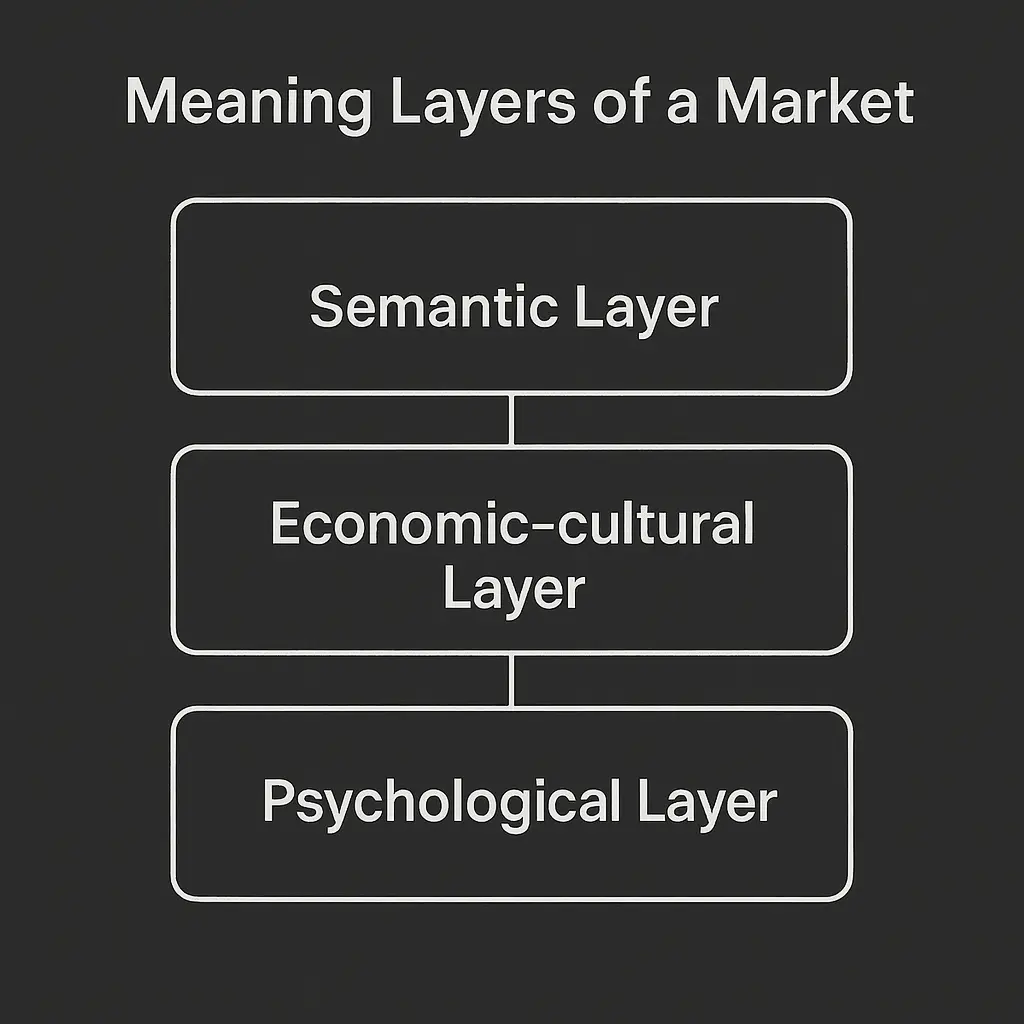
1. The Semantic Layer: How a Market Appears in Search Systems, Narratives, and Meaning Clusters
The semantic layer is the invisible structure of a market. It consists of dominant concept worlds, recurring conversational themes, collectively shared expectations, linguistic patterns, structured entities (economy, politics, technology), and the way AI search systems weigh and prioritize information.
Every market has its own "map of meaning." Search engines and LLMs absorb these meaning spaces and reproduce them in answers, rankings, and recommendations. A SaaS product does not just need translation — it needs semantic positioning. Three examples make this concrete:
Argentina — the semantics of uncertainty, stability, and price logic
Argentina is a market where economic uncertainty structures everyday life. High inflation, volatile prices, strong dollar dependence, and rapid currency devaluation shape the entire semantic landscape. Dominant terms include inflación, estabilidad, dólar, and precio justo.
For SaaS, this means people evaluate software not primarily by features, but by price stability, fair entry thresholds, predictable costs, and the implicit question: "Can I still afford this tomorrow?" A SaaS offering transparent pricing, flexible models, or monthly cancellation aligns with the core of this market's semantic structure.
Mexico — the semantics of efficiency, automation, and productivity
Mexico is a pragmatic growth market with clear economic orientation. Expanding industry, solid digital adoption, focus on process optimization, and increasing competition define its structure. Semantic key fields include eficiencia, automatización, and productividad.
Companies look for tools that save time, automate tasks, make teams more efficient, and deliver measurable results. A SaaS that shows clear before-after examples becomes instantly relevant.
Brazil — the semantics of localization, integrations, and regulation
Brazil is a market with strong internal logic built around local payment systems (Pix, Boleto), unique digital ecosystems, complex regulatory requirements, and strong national brands. The Pix revolution exemplifies this: 93% of adult Brazilians use Pix, and for SaaS providers, Pix represents 61% of Brazilian revenue. Without Pix integration, SaaS companies lose on average 12% of transactions to payment failures.
Dominant semantic clusters include integrações locais, pagamentos, and compliance. A SaaS without local integrations appears fundamentally incomplete.
Why these examples matter: These three countries represent three types of meaning spaces — volatile markets prioritize stability, security, and price; growth-oriented markets prioritize efficiency, automation, and productivity; culturally fragmented markets prioritize locality, integrations, and compliance. The semantic layer determines whether a SaaS product appears meaningful in a given market at all.
2. The Economic-Cultural Layer: How Markets Function and Make Decisions
The second layer focuses not on concepts but on realities: purchasing power, economic dynamics, risk behavior, institutional trust, technological maturity, and communication culture. This layer determines how a market decides.
In Argentina, price increases cause immediate cancellations. In Mexico, bundle models work extremely well. In Brazil, local payment methods are required or conversion collapses. Trust also functions differently across regions. In Latin America, trust often comes from personal communication. In Asia, more from brand authority and technical reliability. In Eastern Europe, from price-performance and speed.
The economic-cultural layer answers: What must a SaaS provide so the market can actually use it?
3. The Psychological Layer: How Brands Are Perceived
The third layer determines whether a product will truly be adopted. People do not buy features — they buy meanings: stability, seriousness, proximity, modernity, fairness, cultural fit. This layer is especially underestimated in emerging markets.
In Argentina, a provider seems credible when acknowledging economic reality ("fair price despite inflation"). In Mexico, credibility comes from demonstrating measurable improvements. In Brazil, it comes from showing cultural closeness and local integrations. Branding is international semantic translation work. It is not about logos — it is about meaning signals.
Why All Three Layers Must Work Together
Only when a SaaS company understands the semantic structure of a market, respects its economic-cultural reality, and meets its psychological expectations do visibility, trust, demand, and loyalty emerge. International expansion is not a technical process. It is a meaning-oriented process that respects the three layers of a market.
III. SM-ESM – Semantic Market Entry Strategy Model
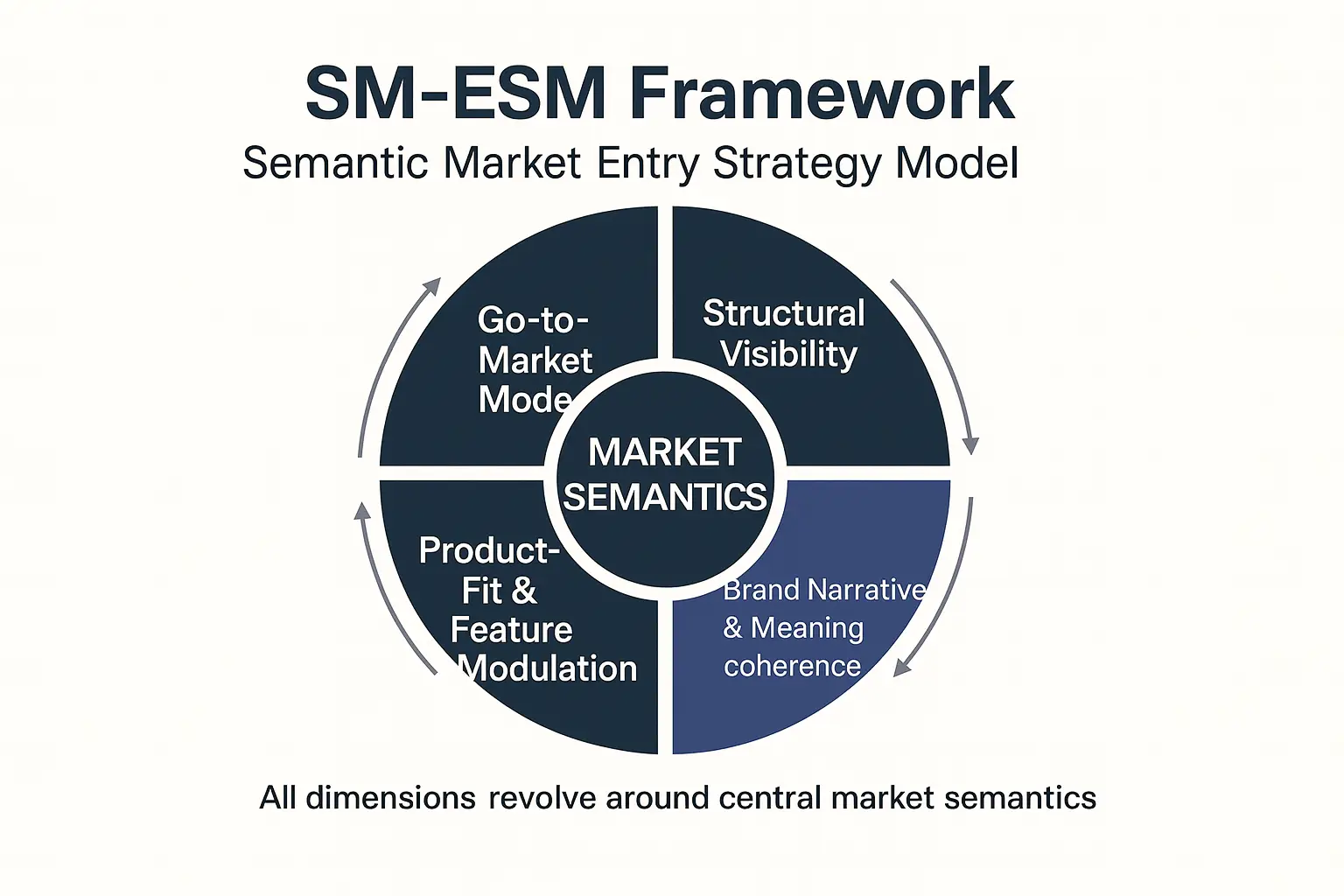
International expansion is not linear. It requires precise translation between product logic and market logic. Yet markets differ fundamentally in structure, semantics, and psychological patterns. The Semantic Market Entry Strategy Model (SM-ESM) provides a systematic approach to this challenge.
The model describes five dimensions that jointly determine whether a SaaS product becomes not only visible, but meaningful in an emerging market — with clear positioning, cultural relevance, and structural compatibility.
1. Market Semantics: Understanding a Country's Core Meaning Structures
Every market has its own semantic DNA that determines how products are perceived, which value propositions resonate, and which narratives fall flat. Market semantics encompasses dominant concept clusters, societal themes, economic realities, technological discourse patterns, political mood and stability, and culturally shaped meaning clusters.
For SaaS, market semantics answers the question: "In what meaning-space does my product appear in this country?" A SaaS product built around "efficiency" will miss the mark in a market whose semantic core revolves around "stability" — unless it aligns with the local meaning system.
Examples: Argentina prioritizes stability, fair pricing, and security. Mexico prioritizes productivity, efficiency, and automation. Brazil prioritizes locality, integrations, and compliance.
Market semantics is the foundation. Misread it, and you position yourself incorrectly. Understand it, and you speak the language the market instantly recognizes.
2. Structural Visibility: International SEO as Semantic Architecture
SEM, SEO, and AI visibility are no longer technical optimizations — they are structured semantic systems. Structural visibility means setting correct international entities, clear country architecture (e.g., /mx, /ar, /br), market-specific semantic content, AI-recognizable market signals, locally relevant pricing structures, technical compatibility, and an internal structure understood by both humans and machines.
Search engines and LLMs do not simply parse language — they evaluate market relevance. A SaaS brand is more likely to be recommended in Mexico if the website clearly shows which local problems it solves, which industries are addressed, and which semantic concepts define demand. Structural visibility is the technical translation of market semantics.
3. Brand Narrative & Meaning Coherence: Culturally Intelligent Branding
Branding in international markets is not visual — it is semantic. The brand narrative answers: "What meaning does my product carry in this market?" Meaning emerges from cultural frames, linguistic alignment, tone and communication style, attitude and stance, thematic priorities, how problems are described, and the perceived function of the product.
A product positioned in Germany as an "efficiency solution" may need to appear as a "stability anchor" in Argentina. Meaning coherence means maintaining the same brand and identity while adapting the narrative. This creates a unified yet culturally intelligent brand presence.
4. Product Fit & Feature Modulation: Functional Alignment with the Market
Many SaaS companies get internationalization wrong by assuming their product works equally well everywhere. Markets have different payment expectations, comfort zones, integration requirements, priorities, and technical infrastructures.
Feature modulation asks: Which features are essential? Which are irrelevant locally? Which must be simplified? Which integrations are mandatory? Which pricing models actually work?
Examples: Argentina requires flexible, fair prices and simplified packages. Mexico responds to automation as a clear value driver. Brazil requires local integrations (Pix, Boleto, local ERPs).
International expansion does not end with marketing — it begins with the product.
5. Go-to-Market Mode: How a Market Is Opened
The final dimension defines the entry mechanism: soft launch (test market, beta, pilot clients), hard launch (full rollout), partnerships (local agencies, consultants, multipliers), community development, onboarding strategy, local support (e.g., WhatsApp-first in LATAM), and entry-stage pricing. Markets behave differently at the moment of adoption.
Examples: In Latin America, proximity often matters more than perfection. In Southern Europe, personal interaction outperforms technical arguments. In many Asian markets, brand presence builds trust faster than explanation.
Why the SM-ESM Framework works: It integrates semantic insights, cultural intelligence, structural SEO, branding, product logic, and go-to-market mechanics. It explains not only what to do — but why it works. SM-ESM reveals a deeper truth: Markets do not decide purely rationally — they decide semantically. International expansion succeeds only when product, language, brand, and structure align with the local meaning system.
IV. Typology of Emerging Markets: Three Classes and Their Core Meanings
Emerging markets are often treated as a single category — "developing countries with growth potential." From a strategic standpoint, they could not be more different. For SaaS companies, it is not geography but a market's meaning-logic that determines which strategies actually work.
The SM-ESM Framework categorizes emerging markets into three market classes to prevent companies from falling into cultural or semantic misalignment. Each class has its own meaning-space and responds to different promises, pricing logics, and branding strategies.
Why This Typology Matters
The three market classes are not abstract categories — they are meaning-spaces that determine how customers evaluate SaaS solutions, which brand promises resonate or fall flat, which pricing models will be accepted, which feature sets are expected or irrelevant, and how SEO, content, and branding must be designed.
Most SaaS companies make one fundamental mistake: they internationalize with a single strategy. What builds trust in Argentina is irrelevant in Mexico. What works in Mexico fails in Brazil. What is necessary in Brazil is unnecessary in Argentina. International expansion does not require one solution — it requires a model that understands which meaning-space a market operates in.
| Market Class | Examples | Core Characteristics | Dominant Meaning Space | Implications for SaaS |
|---|---|---|---|---|
| 1. Volatile High-Dynamics Markets | Argentina, Turkey, Nigeria, Vietnam |
|
Stability · Predictability · Safety · Fairness · Price flexibility |
|
| 2. Growth-Stable Digital Markets | Mexico, Colombia, India, Malaysia, Eastern Europe |
|
Efficiency · Automation · Productivity · Time savings |
|
| 3. Culturally Fragmented Large Markets | Brazil, Indonesia, Philippines, South Africa |
|
Local integrations · Payment methods · Compliance · Cultural proximity |
|
This table provides structural orientation — but strategic decisions require understanding the underlying logic of each market class. The following sections decode how meaning structures translate into concrete strategy: narrative, pricing, product design, and visibility architecture.
1. Volatile High-Dynamics Markets: Stability Beats Sophistication
These markets operate under permanent economic turbulence. Inflation, currency fluctuations, and regulatory uncertainty shape how companies and consumers evaluate software. Purchase decisions are pragmatic and often short-term. Even highly capable teams avoid long commitments because the macroeconomic environment does not allow long-term planning.
For SaaS companies, this means: stability is the narrative. A product must feel safe, predictable, and financially manageable. Feature-rich products often fail — not because they are bad, but because complexity increases perceived risk. SaaS Lite models, transparent pricing, and low-friction onboarding dramatically outperform enterprise-style packages.
Key Insight: In volatile markets, customers don't ask "What can this do?" They ask "Can I still afford this tomorrow?" Pricing flexibility and stability messaging are not features — they are trust anchors.
Strategic Implications:
- Monthly billing with no long-term lock-in
- Transparent, fixed pricing in local currency
- Simplified feature sets that reduce cognitive load
- Brand narrative centered on fairness and predictability
- SEO content around themes like precio justo, estabilidad, sin compromiso
2. Growth-Stable Digital Markets: Efficiency Is the Currency
These markets are characterized by stable economic expectations combined with rapid digital adoption. Companies look for solutions that directly improve efficiency, reduce manual work, and enhance productivity. Digital maturity is rising quickly, and decision-makers often operate with a clear ROI logic.
The winning SaaS narrative here is measurable improvement: "How much time will this save my team?" Demonstrating clear before-after scenarios, automation benefits, and integration simplicity plays a central role. These markets reward clarity, benchmarks, and visible outcomes.
Key Insight: Growth-stable markets are efficiency-obsessed. Decision-makers compare not features but outcomes. A SaaS that can prove "12 hours saved per week" wins over one with 50 features but no measurable impact.
Strategic Implications:
- Value-based pricing tied to team size or usage
- Bundle models that increase perceived value
- Automation-first product messaging
- ROI calculators and before–after case studies
- SEO content around automatización, eficiencia, productividad
- Fast onboarding to demonstrate immediate value
3. Culturally Fragmented Large Markets: Locality Is Non-Negotiable
These markets have deep internal complexity: local payment systems, strong domestic competitors, dominant regional ERPs, and cultural diversity. Customers do not simply buy software — they buy compatibility with local systems, expectations, and norms. Without local integrations, even superior SaaS products appear incomplete.
Brand perception also works differently: foreign providers must prove proximity, adaptation, and respect for local dynamics. Localized onboarding, WhatsApp or chat-based support, and culturally familiar narratives are not "extras" — they are structural requirements for relevance.
Key Insight: In fragmented markets, technical superiority is secondary to cultural fit. A locally integrated "good enough" solution beats a globally superior but culturally distant one. Pix integration in Brazil isn't optional — it's existential.
Strategic Implications:
- Mandatory local payment integrations (Pix, Boleto, local gateways)
- Compliance-ready features aligned with local regulations
- Culturally adapted UI/UX and communication tone
- Local support channels (WhatsApp-first in LATAM)
- SEO content around integrações locais, pagamentos, compliance
- Regional case studies and testimonials from local businesses
Strategic Playbooks per Market Class
| Market Class | Winning Narrative | Effective Pricing | Product Strategy | Visibility Strategy |
|---|---|---|---|---|
| 1. Volatile Markets | Stability · Fairness · Predictability |
|
|
|
| 2. Growth-Stable Markets | Efficiency · Automation · ROI |
|
|
|
| 3. Fragmented Markets | Local Fit · Cultural Proximity · Compliance |
|
|
|
Real-World Scenarios: How SaaS Success Differs Across Classes
Scenario A — CRM Tool in Argentina (Volatile Market): A European CRM provider enters Argentina with its standard EUR 79/month plan and annual billing. Result: high bounce rate, minimal conversions. The price feels unstable in a currency-volatile market, and annual commitment is psychologically impossible when inflation runs at 100%+. Adjusted Strategy: Launch a "Plan Estable" at ARS equivalent of $29/month, monthly billing, transparent local pricing. Messaging: "Sin compromiso anual. Precio justo y predecible." Adoption increases 340% within 90 days.
Scenario B — Automation SaaS in Mexico (Growth-Stable Market): A workflow automation tool struggles to gain traction despite having 50+ features. The problem: messaging focuses on "all-in-one platform" rather than specific outcomes. Adjusted Strategy: Reframe entire site around efficiency: "Ahorra 12 horas semanales automatizando tareas repetitivas." Add before–after calculators. Create industry-specific landing pages. Conversion rate triples. Why? The market doesn't buy features — it buys time.
Scenario C — Analytics SaaS in Brazil (Fragmented Market): A data analytics platform launches in Brazil with Stripe-only payments and English-language support. Despite technical superiority, adoption stalls. No Pix integration means 61% of revenue is lost to payment failures. Adjusted Strategy: Integrate Pix and Boleto. Launch Portuguese site with local case studies. Add WhatsApp support. Partner with Brazilian ERP providers. Market share grows from 2% to 23% in 6 months. The product didn't change — the cultural fit did.
Edge Cases and Hybrid Markets
Not all markets fit cleanly into one class. Some exhibit characteristics of multiple classes, requiring hybrid strategies:
- India: Growth-stable + culturally fragmented. Requires efficiency narrative AND local integrations (UPI, regional languages).
- Vietnam: Transitioning from volatile to growth-stable. Pricing flexibility still matters, but efficiency messaging is gaining traction.
- South Africa: Fragmented + partially volatile. Local payment methods essential, but economic uncertainty requires flexible pricing.
For hybrid markets, the SM-ESM Framework recommends: prioritize the dominant meaning-space first, then layer secondary elements.
V. Strategic Visibility: How SaaS Brands Capture International Demand
International market entry rarely fails because of the product or technology. It fails because SaaS companies do not become visible in a new market — not in search engines, not in AI-driven answer systems, and not in the cultural conversation spaces of the country. Strategic visibility is not created through translation or keyword-based SEO. It is created through clean semantic structure, credible brand meaning, and AI-readable signals.
SaaS companies achieve international visibility when five elements align: semantic relevance, structural clarity, narrative compatibility, technical compatibility, and cultural authenticity. Together, these form an international visibility architecture that goes far beyond rankings.
1. International SEO Is Semantic, Not Linguistic
Traditional SEO models rely on translations, keywords, and on-page factors. In an international context, this is far too shallow. Modern search systems — especially AI-based ones — rely on entities, meaning clusters, market semantics, problem landscapes, country-specific user intent, and cultural language fields. This means a market is not accessed through words but through meanings.
Example: A SaaS product for "automation" must communicate efficiency in Mexico but must signal stability first in Argentina. Otherwise, it appears irrelevant.
A website achieves international visibility when it uses semantically relevant terms for each country, anchors country-specific entities, reflects the local problem landscape, sends clear market signals to AI systems, and mirrors local competition and narratives. In short: A website must speak the way a market thinks.
2. Pricing, Local Pages & Market Narratives
Visibility is not just SEO — it is structural website architecture. Every country needs its own landing page, a clear semantic position, country-specific pricing logic, local integrations, a defined narrative, and cultural compatibility.
Different markets react strongly to specific triggers. Argentina responds to monthly cancellation. Mexico responds to package pricing. Brazil requires local payment methods. Colombia values regional case studies. LATAM in general expects WhatsApp-first support. A compelling international pricing story is often the key growth lever.
SaaS that communicates price stability wins in volatile markets. SaaS that demonstrates time savings wins in efficiency-driven markets. SaaS with local integrations is the only one accepted in culturally distinct markets.
3. Semantic Trust Signals
In emerging markets, trust is the most valuable currency. It is not created by features or design but by signals that match cultural expectations: local support, named human contacts, local examples, familiar payment methods, clear and simple pricing, and a narrative aligned with market semantics. Trust is always semantic — it is created by the meaning a product produces in the mind of the market.
A SaaS that signals "We understand how your market works" gains immediate cultural advantage.
4. RAG-Readiness & AI Visibility
We now operate in a world where AI systems do not just answer — they distribute visibility. RAG-based architectures, answer engines, and semantic search frameworks depend on clear entities, structured data, coherent internal logic, unambiguous market signals, and semantic consistency across countries.
To become internationally visible, a SaaS needs entity mapping (product, markets, industries, integrations), market clusters per country, clean content structure, harmonized but localized narratives, clear integration and use-case signals, and technical AI readability. A globally scaling SaaS website must write for humans, search engines, entity models, AI aggregators, and semantic answer systems. This is not a trend — it is structural reality.
5. Cultural Authenticity: The Invisible Competitive Advantage
The most underestimated factor: A market immediately senses whether a brand is culturally compatible. Cultural authenticity means no generic translation, no 1:1 Western corporate language, no cold enterprise messaging — but real closeness, cultural sensitivity, locally relevant visuals, and a tone that feels native.
A provider that feels culturally distant or arrogant loses immediately. Authenticity does not mean pretending. It means respecting the meaning structure of a market.
The Formula for International Visibility:
Market Semantics + Structure + Narrative + Product Fit + Cultural Alignment = International Visibility
SaaS companies that align these five elements become visible, relevant, trusted, and scalable. They don't just win rankings — they win market acceptance.
Mini-Comparison: Digital Markets in Latin America (AR / MX / BR)
| Country | Digital Market – Key Figures | SaaS-Relevant Insights | Dominant Market Semantics | Buying Logic |
|---|---|---|---|---|
| Argentina |
|
|
Stability · Predictability · Fair price | "Use it as long as I can afford it." |
| Mexico |
|
|
Efficiency · Automation · Productivity | "How many hours does this save me per week?" |
| Brazil |
|
|
Local integrations · Payments · Compliance | "Show me how you fit into our system." |
VI. Common Mistakes in SaaS Internationalization
Most SaaS companies do not fail because of technology, product quality, or insufficient demand. They fail because they operate with wrong assumptions about markets and apply strategies that work in Western countries but lose effectiveness in emerging markets. Below are the most common mistakes made by 90% of SaaS companies — and why they are especially damaging in emerging markets.
1. Applying Western Pricing Logic to Emerging Markets
A SaaS that costs USD 49–99 per month in Germany is often perceived as a luxury product in many emerging markets — regardless of its value. Monthly prices don't match local purchasing power, no regional pricing exists, dollar pricing ignores currency volatility, and long-term commitments without month-to-month options drive churn before customers even try the product. The correct approach: flexible pricing, fair starter models, monthly cancellability, transparent costs.
2. Feature Overload: Products Too Complex for Markets That Require Simplicity
In many emerging markets, time is scarce, teams are small, digital maturity varies, and fast onboarding is crucial. Too many features, overly complex dashboards, long learning curves, and too many irrelevant integration options all repel adoption. The correct approach: SaaS Lite — clear core features, radical simplification, immediately understandable results.
3. Translating Text Instead of Adapting Meaning
Text is translated but meaning is not. U.S. or European wording remains unchanged, with no alignment of the narrative to local meaning structures and cultural frames ignored. The consequence: the product feels foreign, inappropriate, or even arrogant. The correct approach: Localization = Translation + Meaning + Context + Culture, with semantic adaptation to Market Class 1, 2, or 3.
4. Ignoring Market Semantics in SEO and AI Visibility
Many companies copy the same SEO strategy for every country, use the same keyword sets, ignore local entities and cultural search patterns, and think linguistically instead of semantically. The problem: LLMs and search engines identify markets through meaning clusters, not literal translations. The correct approach: SEO based on semantic market logic — problem clusters, entities, cultural themes, narratives, market signals.
5. Missing Local Integrations
Especially in culturally fragmented markets (Brazil, Indonesia, South Africa), SaaS companies fail by believing "our product works the same everywhere." But payment systems differ, ERP systems are locally anchored, compliance requirements vary, and integrations determine conversion or abandonment. The consequence: the product is perceived as "incomplete" or "not built for us."
6. Missing Trust Layer: The Most Important Factor in Emerging Markets
Many global brands underestimate how strongly trust is shaped by real people, local partners, fast communication, transparency, and support proximity. Anonymous support structures, cold and distant communication, no WhatsApp support, and branding that feels abstract or corporate all destroy trust. The correct approach: cultural closeness — human signals, local, fast, personal support.
7. No Structural Signals for AI Systems
A modern mistake nearly everyone makes: no clear entity logic, missing structural relationships, unclear market assignment, content not AI-visible, too many isolated pages without semantic edges. The consequence: you do not appear in AI-generated answers — even though your company exists. Structure = Semantics = Visibility. AI needs clear meaning anchors and structured signals.
8. Projecting Western Narratives Onto Non-Western Markets
"Enterprise-grade" is irrelevant in volatile markets. "Complex automations" is overwhelming in low digital maturity markets. "All-in-one suite" is intimidating where trust is low. "Scalability" is secondary in markets that need stability first. Marketing speaks past the market. The correct approach: the product narrative must reflect the market narrative — not the other way around.
Why error analysis strengthens thought leadership: Understanding why companies fail — and being able to translate those failures into meaning — is the highest form of strategic competence.
Theoretically understood, practically misapplied
Missing local integrations · No structural AI signals
Optimal target state
Semantically & culturally aligned internationalization
Fundamental misconceptions
Western pricing logic applied · Projection of Western narratives
Hyperactive but misguided
Feature overload · Pure translation-localization · Ignoring market semantics · Missing trust layer
VII. Conclusion: The Future of SaaS Growth Is Semantic, International, and Emergent
The international expansion of SaaS companies has reached a turning point. While Western markets are increasingly saturated and expensive, emerging markets are opening new spaces for growth, innovation, and brand building. But these spaces do not follow a universal logic. They are shaped by distinct layers of meaning: economic realities, cultural narratives, local technologies, and psychological expectations.
The critical mistake many SaaS providers make is entering these markets with Western models — fixed pricing logics, inflexible narratives, generic localization, and technical structures that fail to reflect the semantics of a market. Yet markets do not decide purely rationally. They decide semantically.
This is exactly where the SM-ESM Framework comes in. It explains how international visibility, cultural alignment, and market understanding interact. It shows why each market class requires its own strategy, and why SaaS products do not win through features alone, but through meaning: stability in volatile markets, efficiency in growth-oriented markets, locality in culturally fragmented large markets.
International expansion is therefore not the export of software. It is the expansion of a meaning system.
The SaaS companies that succeed in the future will be those that:
- Take market semantics seriously
- Adapt their product modularly
- Translate narratives with cultural intelligence
- Create structural visibility for AI-driven systems
- Build trust through proximity, clarity, and local relevance
- Shape their brand identity so it carries credible meaning in every market
The real growth opportunities do not lie where competition is loudest, but where meaning resonates most deeply. Emerging markets are not replacement markets — they are the next frontier of global SaaS expansion. Semantic, cultural, structural.
The SM-ESM Framework provides the roadmap. The question is not whether to enter emerging markets — but whether you're willing to understand them first.
Those who do not merely enter these markets — but understand them — will not simply become visible.
They will become relevant.
And in the age of AI, relevance is the new form of market leadership.
Work with Marcus A. Volz
Planning international expansion?
I help SaaS companies enter emerging markets with precision — through semantic market analysis, international SEO architecture, and culturally intelligent positioning. If you want to validate your approach against the SM-ESM Framework or map the semantic structure of your target market, let's talk.