Why B2B SEO Should Start With the Buying Center
Keyword research tells us what is searched. In complex B2B markets, it does not tell us which stakeholder is searching, what decision that person is trying to make, or which internal question the search is meant to resolve.
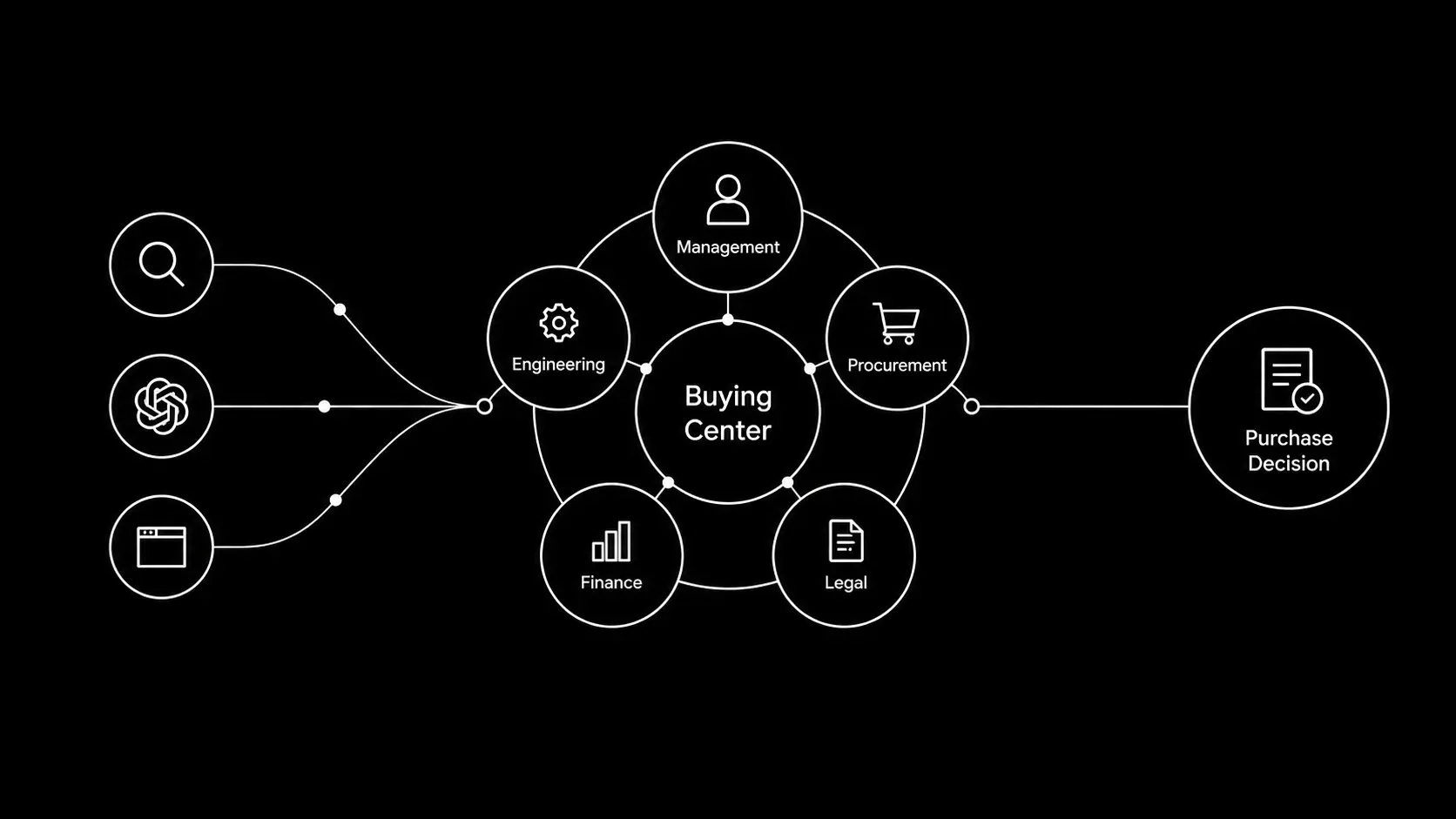
B2B SEO should begin with an understanding of the buyer. In complex purchases, that understanding needs to go deeper: into the buying center, the roles involved, the tasks and risks of its members, and the questions that arise during the purchase process. Search intent, topics, keywords and content architecture can then be derived from that structure.
1. B2B SEO often starts too late
Most SEO projects begin with a familiar sequence: identify keywords, group them by intent, assess search demand, map topics to pages and produce content. That sequence is useful, but in complex B2B markets it can begin after an important strategic question has already been skipped.
Who inside the customer organisation is actually trying to make the decision?
A search for a technical specification, a supplier comparison, a compliance requirement and an ROI calculation can all relate to the same purchase. They may be initiated by different people, at different moments, for different reasons. Treating those searches as one undifferentiated keyword universe can hide the structure behind the demand.
The central proposition
B2B SEO should begin with an understanding of the buyer. In complex purchases, that understanding needs to extend to the decision structure around the purchase. Keywords are evidence of information demand. The buying center helps explain where that demand comes from and why different people may search for different answers around the same decision.
The concept itself is not new. Frederick E. Webster Jr. and Yoram Wind framed organizational buying as an organisational decision-making process in their 1972 Journal of Marketing paper, A General Model for Understanding Organizational Buying Behavior. The value of revisiting that model today is that much of the information-seeking activity around a buying decision now leaves a digital trace through search, websites, reviews, professional content and AI interfaces.
2. The buying group is the decision unit
Recent B2B research reinforces the importance of looking beyond a single target buyer. LinkedIn and Bain's 2026 research describes the buying group as the unit of decision-making in B2B. It also finds that finance, legal and procurement can collectively hold roughly half of the decision influence, even though these stakeholders may be largely invisible in a conventional marketing funnel.
The same research reported that 81% of purchases in its study went to vendors already known by almost everyone in the buying group at the start of the process. Only 4% went to vendors known solely by the recommending function. The implication for search strategy is significant: visibility and credibility may need to be built across several internal audiences rather than around one functional champion.
Edelman and LinkedIn's 2025 research adds another dimension. Their study of nearly 2,000 professionals found that so-called hidden buyers in functions such as finance, legal, compliance, procurement and operations actively discover, consume and evaluate thought leadership. They may never become the obvious lead in a CRM system, yet their information needs can still influence whether a supplier progresses.
| Buying-center role | Typical question | Likely information need |
|---|---|---|
| Engineering / Technical | Will this work in our environment? | Specifications, compatibility, performance, standards, applications |
| Procurement | Can this supplier meet our commercial requirements? | Supplier credentials, availability, terms, alternatives, delivery capability |
| Finance | Can the investment be justified? | Total cost, ROI, risk, payback, financial implications |
| Legal / Compliance | Can the decision be defended and approved? | Regulation, certifications, security, contractual and compliance evidence |
| Management | Is this the right strategic choice? | Business case, reputation, references, strategic fit, implementation risk |
These are examples rather than universal role definitions. Buying centers vary by industry, company size, purchase value and product complexity. That variation is precisely why the buying center should be investigated before the search strategy is built.
3. Buying processes are not linear
Gartner's B2B buying framework provides a useful bridge between organizational buying and search behaviour. It describes six recurring buying jobs: problem identification, solution exploration, requirements building, supplier selection, validation and consensus creation.
Gartner explicitly describes the process as non-linear. Buying groups loop back through tasks as new information, uncertainty and additional stakeholders enter the process. At different points, stakeholders may use supplier websites, social media, digital tools and other channels while completing these jobs.
Problem identification
The search task is often diagnostic: understanding the problem, its causes, scale and business implications.
Solution exploration and requirements building
The search task shifts toward available approaches, technologies, requirements, standards and evaluation criteria.
Supplier selection and validation
Searches become more vendor-specific and evidence-heavy: comparisons, references, certifications, reviews, technical proof and implementation details.
Consensus creation
The information need can change again. Internal stakeholders may need evidence that helps justify the decision to colleagues who evaluate risk from a different perspective.
This is where a buying-center-first SEO model becomes more useful than a simple funnel. The same stakeholder can revisit earlier questions, and different stakeholders can enter the process with different levels of knowledge. Search intent can therefore reflect both the buyer role and the buying job being completed.
4. Much of the preference formation happens before Sales
The 2025 B2B Buyer Experience Report from 6sense surveyed nearly 4,000 buyers. In its sample, buying groups averaged more than ten members for deals with a minimum value of about US$25,000. Buyers reported that they first engaged sellers at around 61% of the way through the journey, while 94% had already ranked their shortlist before speaking with sellers.
The vendor contacted first won close to 80% of deals. The report also found that buyers initiated 79% of first engagements.
SEO is operating before the sales conversation
If buyers form requirements, compare alternatives and rank suppliers before direct engagement, organic and AI-mediated visibility can influence the decision environment before a salesperson knows the opportunity exists.
This does not mean search alone determines the purchase. Prior experience, brand familiarity, peer recommendations, analyst views, existing supplier relationships and offline interactions remain important. It does mean that the pre-contact information environment deserves to be mapped with the same seriousness as the later sales process.
5. B2B search behaviour now extends beyond Google
A buying-center approach also helps avoid a second limitation in conventional SEO: equating search behaviour with Google keyword demand.
McKinsey's 2026 Global B2B Pulse, based on nearly 4,000 decision-makers across 13 countries, found that buyers use an average of ten channels across the purchasing journey. The website remains one part of a wider information system that can include digital self-service, remote interaction and human sales channels.
AI interfaces are becoming part of that system. G2's 2026 AI Search Insight Report, which focuses specifically on B2B software buyers, found that 51% said they start research with an AI chatbot more often than with Google. At the same time, 80% still use Google somewhere in the buying journey. The result is not a clean replacement of one channel by another. Research is distributed across several interfaces.
A Gartner survey published in March 2026, based on research fielded in late 2025 with 646 B2B buyers, points in the same direction. Sixty-seven percent said they preferred a rep-free experience, and 45% reported using AI during a recent purchase. These results apply to Gartner's survey population and should not be generalised mechanically across every B2B market, but they reinforce the broader shift toward self-directed digital research.
Search behaviour is now broader than a keyword list
For B2B SEO, the relevant question is increasingly where and how each stakeholder seeks an answer: traditional search, AI search, vendor websites, specialist media, reviews, professional networks, reports, documentation or direct expert interaction.
6. The Buying-Center-First B2B SEO Framework
The practical implication is a change in sequence. Instead of starting with a keyword database and then trying to infer the audience, the analysis can move from the decision structure outward.
The framework below is my synthesis of established buying-center research, buying-job models and search-strategy practice. The individual concepts are not new. The contribution is the sequence: connecting the internal decision structure of a B2B purchase to the questions that generate search behaviour, and from there to search intent and content architecture.
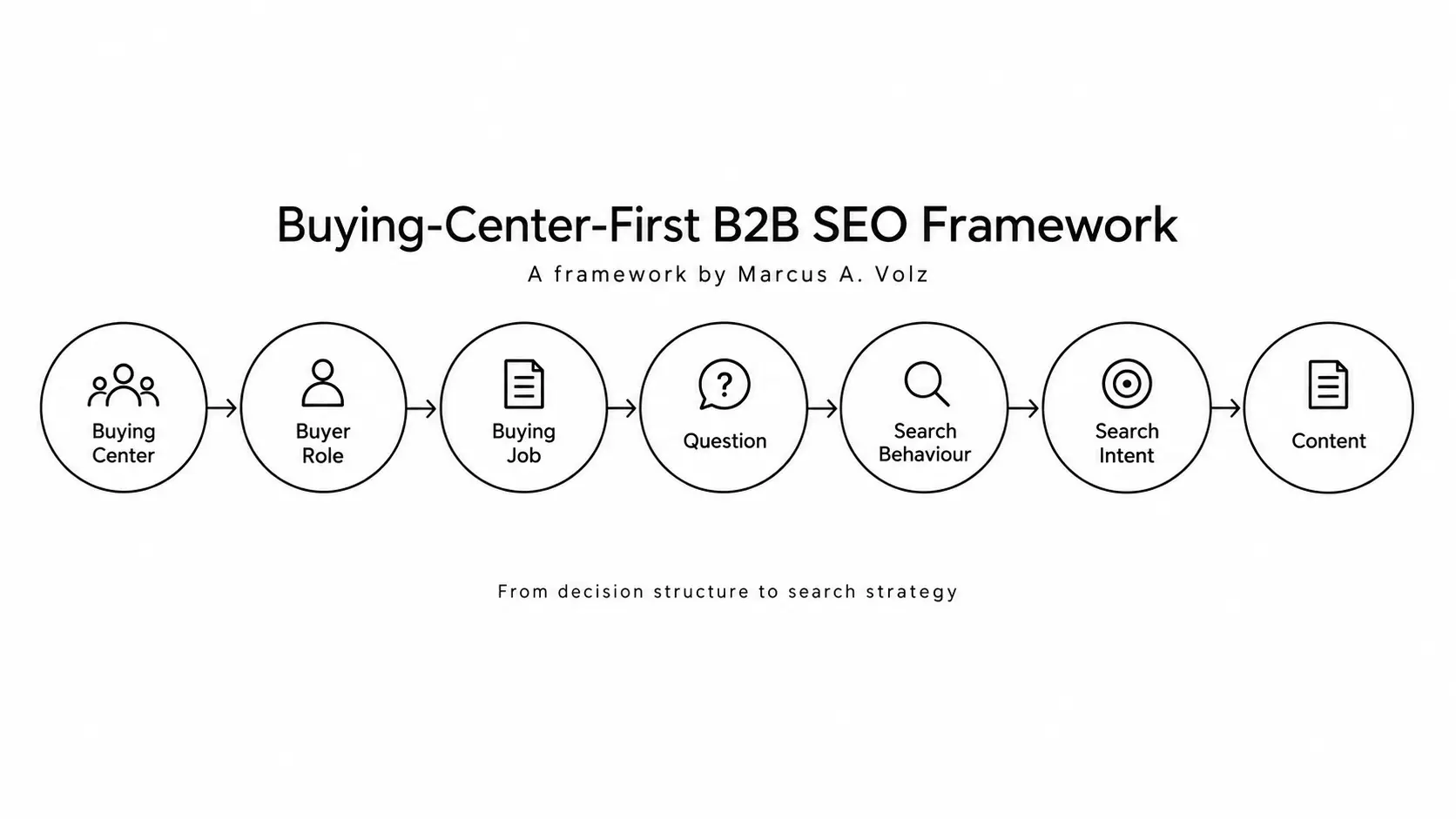
Step 1: Map the buying center
Identify the functions that can initiate, specify, evaluate, approve, block, purchase or use the solution. The purpose is not to create fictional personas. It is to understand which organisational roles materially influence the decision.
Step 2: Map the buying jobs and risks
For each relevant role, determine what has to be understood or resolved at different stages of the purchase. Technical feasibility, commercial viability, compliance, implementation risk and internal defensibility can generate different research tasks.
Step 3: Turn jobs into real questions
Questions should be derived from interviews, sales conversations, customer-service records, tender documents, industry forums, search data and other direct evidence where available. This creates a bridge between organisational behaviour and observable information demand.
Step 4: Investigate how those questions are researched
Some questions generate conventional search queries. Others are increasingly asked through AI tools, answered through vendor documentation, validated on review platforms or researched in specialist media. Channel choice is part of the analysis.
Step 5: Build search intent and content architecture from the evidence
Only at this stage do keywords, entities, topics, landing pages, comparison pages, technical resources, FAQs, case studies and thought leadership become the operational SEO layer.
7. What changes in practice?
A conventional keyword model may show that several terms belong to the same commercial topic. A buying-center model can show why they should not necessarily be served by the same page.
An engineer looking for compatibility data, a procurement manager checking supplier capability and a finance stakeholder testing the business case may all be part of one purchase. Their searches can overlap semantically while requiring different evidence. A page optimised around the highest-volume term can rank and still fail to support the decision.
The same logic changes content measurement. Traffic remains useful, but the strategic question becomes whether the site covers the information requirements that influence selection, validation and internal consensus. In low-volume B2B markets, a technically narrow page used by a critical stakeholder can be more commercially important than a broadly trafficked article.
The SEO question changes
Instead of asking only “Which keywords should this company rank for?”, the analysis asks: “Which people influence the purchase, which questions do they need to resolve, and where does search enter that decision process?”
This does not replace keyword research, technical SEO or search-demand analysis. It adds a deeper buyer layer where the purchase process requires it. The buying center explains the organisational context. Buying jobs explain the task. Search behaviour reveals where information is sought. SEO then determines how that information can be found and understood.
8. How deep the buyer analysis needs to go
Understanding the buyer should always come first. The question is how deep that analysis needs to go before the SEO work begins.
For a short, standardised purchase with one dominant buyer or user, a relatively light analysis may be enough. Understanding the primary buyer, the problem being solved, the search intent and the observable demand can provide a sufficient basis for keyword research, information architecture and content planning.
The situation changes when several people influence the same purchase. Different stakeholders may evaluate different risks, ask different questions and require different evidence before the organisation can move forward. In those cases, a general target-group description is often too shallow. The buying center, buyer roles and buying jobs become part of the SEO analysis.
| Signal | Deeper Buying-Center-First analysis is especially useful | A lighter buyer analysis is usually sufficient |
|---|---|---|
| Sales cycle | Long, multi-stage or consultative sales cycles | Shorter, more direct purchase journeys |
| Deal value and risk | High-ticket, high-risk or strategically sensitive purchases | Lower-risk, routine or easily reversible purchases |
| Stakeholders | Several functions can influence, approve, block or validate the decision | One dominant buyer, user or decision-maker drives most of the process |
| Offer complexity | Technical, regulated, customised, integrated or service-intensive solutions | Standardised products or clearly defined services |
| Information needs | Different roles require different evidence: technical, financial, legal, operational or strategic | Most searchers need broadly the same information before acting |
| Search economics | Low search volume can still carry high commercial value per relevant visitor or account | Higher-volume demand can be captured effectively through topic, intent and keyword structure |
| Internal consensus | The purchase must be justified across departments or management levels | Little internal alignment is required beyond the main buyer |
My rule of thumb
If one person can search, evaluate and buy with relatively little internal coordination, understanding the primary buyer, search intent and demand may be enough. If several stakeholders need different answers before the organisation can buy, I would map the buying center and its buying jobs in much more detail.
This also means the framework does not have to be applied across an entire website. Many B2B companies will benefit from a lighter approach for standardised offers and informational content, while using the Buying-Center-First layer selectively where commercial complexity is highest: high-value solution pages, technical product categories, regulated offers, enterprise services, comparison content, case studies and late-stage validation material.
The additional depth has a cost. Interviews, stakeholder mapping and buying-job analysis require time and evidence. That effort is justified when the commercial value and decision complexity are high enough to make a shallow view of the buyer risky. In simpler situations, the lighter method is usually more efficient.
The distinction I would make
Buyer understanding should always come first. The Buying-Center-First framework adds depth when several stakeholders, buying jobs and information needs shape the same purchase.
Sources and research notes
Selected sources
- Webster, F. E. Jr. & Wind, Y. (1972), A General Model for Understanding Organizational Buying Behavior, Journal of Marketing, 36(2), 12–19.
- Gartner, B2B Buying: How Top CSOs and CMOs Optimize the Journey. Used here for the six buying jobs and the non-linear “looping” model.
- LinkedIn & Bain (2026), The Principles of Buyability.
- 6sense (2025), 2025 B2B Buyer Experience Report, based on nearly 4,000 B2B buyers.
- G2 (2026), The Answer Economy: 2026 AI Search Insight Report. The reported AI-search figures refer specifically to B2B software buyers.
- McKinsey & Company (2026), The surprising economics of B2B growth, based on the 2026 Global B2B Pulse survey.
- Edelman & LinkedIn (2025), 2025 B2B Thought Leadership Impact Report, focused on visible and hidden buyers.
- Gartner (2026), Gartner Sales Survey Finds 67% of B2B Buyers Prefer a Rep-Free Experience.
Method note: The cited studies use different samples, industries and purchase contexts. Their figures should therefore be read within the scope of each study rather than combined as if they described one common buyer population. The Buying-Center-First B2B SEO Framework presented here is my analytical synthesis of established buying-center research, buying-job models and search-strategy practice; it should not be read as a framework published by the cited research organisations.